Showing posts with label consensus. Show all posts

Monday, August 5, 2019

Plausible deniability = consensus

Consensus & collaboration… If we were hoping they were the buzz words of 2012, then the bad news is the conversation is as fierce and ongoing in 2019 as then.

Today, during a stimulating breakfast conversation with a wonderful woman, the topic was raised. "Grrr," I growled. "Consensus is another form of political correctness: needed in certain instances and a case of plausible deniability in others."

Plausible deniability is when a group uses consensus to reach a loose decision and then individuals feel free to distance themselves (in opinion or action) from the outcome of the meeting. It's lip service.  It's the equivalent of saying "Yes, that's what we agreed but not what I supported."

What does true collaboration look like in your world? How do you handle plausible deniability?

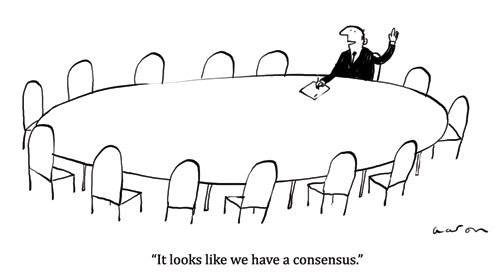
Image result for consensus funny

Tuesday, September 1, 2015

Women in Leadership - who gets to join?

After a few hot debates last month on what is/is not a WIL issue, a few things were clear:

  • Not everyone understands why WIL conversations & actions are even necessary
  • No one agrees on the issues and root causes
  • Some women remain embarrassed by any WIL association with their career

That's all okay. Really. If we all agreed, it would be consensus and we know consensus is not always the way to work things through.

Given the proliferation of diversity discussions happening, there has been a similar growth in smaller "specialty" groups to drive more specific agendas. Shining bright lights in dark places should always be applauded! Each issue women face around the world has its own campaigns, support networks, etc; but sometimes this makes it harder for women in differing groups to support each other.

Questions I heard in August:

  • Is discrimination faced by lesbians a WIL issue?
  • If the majority of elder care is done by women, but men are involved, does it make it not a women's issue?
  • If, as a woman, I've never dealt with bad career options due to my gender - does that mean I still need to speak up for other women?
  • How much of WIL is whining?
  • How much of WIL is just good old career questions with people looking for a shortcut?
  • Why are female role models important? Why not gender-neutral?
  • How can WIL encompass sexual harassment and mentoring in the same umbrella?


I feel passionately about some of these questions. However, it's not the answers that are important as much as we continue the dialogue. Ethics and morals are personal ... but open dialogue helps some of the darker choices lose their power.

Monday, January 12, 2015

Plausible deniability = consensus

Consensus & collaboration… If we were hoping they were the buzz words of 2012, then the bad news is the conversation is as fierce and ongoing today as then.

Today, during a stimulating breakfast conversation with a wonderful woman, the topic was raised. "Grrr," I growled. "Consensus is another form of political correctness: needed in certain instances and a case of plausible deniability in others."

Plausible deniability is when a group uses consensus to reach a loose decision and then individuals feel free to distance themselves (in opinion or action) from the outcome of the meeting. It's lip service.  It's the equivalent of saying "Yes, that's what we agreed but not what I supported."

What does true collaboration look like in your world? How do you handle plausible deniability?

Wednesday, September 10, 2014

Consensus is the lowest bar

Consensus and collaboration are two words often used interchangeably. However, they are two separate approaches to planning.

Often, folks who defer mainly to consensus are afraid to be a bit controversial or are not sure if they own the final decision. And it's much easier to feel the love if you can get everyone to agree.

But consensus can mean we don't take as many risks. It can set a lower bar.

Collaborate always. Everyone who has a stake in the outcome should feed into a decision. However, the party responsible should take the ultimate ownership of the final direction/decision.

Thoughts?

Monday, May 20, 2013

Collaboration & consensus again...

It seems lots of folks are still in the collaboration vs. consensus debate. One friend remarked to me last week that many don't realize that consensus is the easy way out: you put in your vote and hold up the process until everyone agrees. Collaboration, she remarked, requires trust. Trust that:
  • You'll consider my idea before rejecting it
  • I will feel like I had input even if I don't agree with the final direction
  • You know what you're doing
  • We will jointly take responsibility regardless of dis/agreement along the way

Trust is tricky. We're required to give it - at least officially - in work environments. In personal situations, we can take a long time to offer trust. In work environments, folks are more reluctant to overtly express doubt and thus the real conversations are sidebars and the public conversations/meetings have a 'happy face' on them. Collaboration implies there are fewer sidebar conversations. Consensus implies we've all got CYA syndrome; until I'm sure I'm covered, you don't get my vote.

Maybe this is because both trust and collaboration require effort. It's easy to vote / offer an opinion. It's harder to make thoughtful contributions for which you're also willing to do the planning /details / work. It's hard to put yourself on the line, put ego aside, take on someone else's cause /project. It's really difficult to implicitly offer the promise that we'll fail or succeed jointly And I will follow your lead even when I think it's not the best path.

Perhaps trust is built through communication.

Recently, I was trying to collaborate for a project in my personal life. My project, my dollars, etc... so I had the final word but my collaborator had some great expertise. Well, my collaborator disagreed with all my requirements and made decisions without me, then would try to get my agreement after the fact or simply not be responsive to questions and requests. There was no real collaboration as no one was listening to me. We would meet and come to consensus and then nothing would change. The project faltered. My collaborator blamed everyone but himself. His inability to take responsibilty killed the final spark of collaboration I could muster. I know I should have set up stricter guidelines, better communication expectations and proper project protocol but I like a lot of rope to maneouver so I offer lots; usually it works out.

The project is now back on track with a new team who not only seem to collaborate well, they communicate. With more communication comes more trust.

We can't always immediately create trust within our project teams. We can't always restart projects. We can always communicate - from the beginning, through crises, to wherever the need takes us. Trust and collaboration may feel elusive but communication is always a ready skill to build a bridge.