Showing posts with label collaboration. Show all posts

Monday, June 15, 2020

The world needs mentors - you

Regardless of where you are in your career, you have something to contribute. Your experiences are valuable. Your caring is even more valuable. Your willingness to try? Priceless.

Benefits
Attributes
Outcomes
Considered best practice for career planning
Collaborative
A safe place for open and deep discussions
Opens endless doors to people, knowledge and networks
Relationship-based
Deliberate connecting and sharing
Stimulates new ideas
Candid and respectful 
Challenges and questions assumptions
Ensures participants can find their areas of strength
Inclusive and focused
Personal satisfaction and recharged projects 
Attracts high-potential individuals to sectors and/or opportunities that offer value beyond the traditional rewards
Authentic and growth-oriented
Option to make deliberate choices and changes

Monday, August 5, 2019

Plausible deniability = consensus

Consensus & collaboration… If we were hoping they were the buzz words of 2012, then the bad news is the conversation is as fierce and ongoing in 2019 as then.

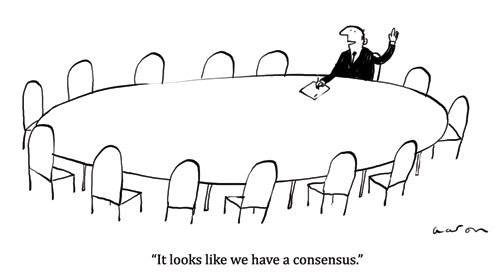
Today, during a stimulating breakfast conversation with a wonderful woman, the topic was raised. "Grrr," I growled. "Consensus is another form of political correctness: needed in certain instances and a case of plausible deniability in others."

Plausible deniability is when a group uses consensus to reach a loose decision and then individuals feel free to distance themselves (in opinion or action) from the outcome of the meeting. It's lip service.  It's the equivalent of saying "Yes, that's what we agreed but not what I supported."

What does true collaboration look like in your world? How do you handle plausible deniability?

Image result for consensus funny

Monday, January 18, 2016

Jumping to solution?

"Sometimes an answer/approach/tactic is not enough. It's best to explain the question before requesting execution of the resolution..."

So said me at a meeting last week. At which point I was shouted down and told the deadline was too tight for discussion and we had to get 'er done! 

Which is ok - because we can ask the questions while executing. Iterative approach and discussion do not mean waiting unless we have mapped all the routes before we start the journey. 

It's just never ok to not ask questions and clarify the problem we're trying to solve - at any stage!

Tuesday, July 14, 2015

Collaboration thought

Collaboration is terrific and a great foundation.

I think we're past the point where we should be getting excited about seeing collaboration in our own team(s). It's time to applaud and support collaboration between teams - thanking those who join our journey or who invite us to join theirs.

Real life - you and your doctor should be collaborating on your health. When the doctor sends you to a specialist; often the specialist acts like it's a new or different team into which you're being allowed. Not so. It's one team. Not only should the specialist send your doctor a copy of their findings but you should tell the doctor how you were/were not treated appropriately.

Real life - you and your team work on a project. You go to a specialist team for a piece you can't do in-house or in your division. It needs to be collaborative. Ownership of delivering a good result did not cease when you included more people from elsewhere. Nor does it mean that the new players are not now responsible for good results.

The quickest way to get to collaboration is ask for and acknowledge it - good and bad. Applaud partners loudly. Offer our own teams. Ensure feedback and ownership is discussed. Collaboration is both habit and process - both of which need to be deliberately done. Thoughts?

Monday, January 12, 2015

Plausible deniability = consensus

Consensus & collaboration… If we were hoping they were the buzz words of 2012, then the bad news is the conversation is as fierce and ongoing today as then.

Today, during a stimulating breakfast conversation with a wonderful woman, the topic was raised. "Grrr," I growled. "Consensus is another form of political correctness: needed in certain instances and a case of plausible deniability in others."

Plausible deniability is when a group uses consensus to reach a loose decision and then individuals feel free to distance themselves (in opinion or action) from the outcome of the meeting. It's lip service.  It's the equivalent of saying "Yes, that's what we agreed but not what I supported."

What does true collaboration look like in your world? How do you handle plausible deniability?

Wednesday, September 10, 2014

Consensus is the lowest bar

Consensus and collaboration are two words often used interchangeably. However, they are two separate approaches to planning.

Often, folks who defer mainly to consensus are afraid to be a bit controversial or are not sure if they own the final decision. And it's much easier to feel the love if you can get everyone to agree.

But consensus can mean we don't take as many risks. It can set a lower bar.

Collaborate always. Everyone who has a stake in the outcome should feed into a decision. However, the party responsible should take the ultimate ownership of the final direction/decision.

Thoughts?

Monday, May 20, 2013

Collaboration & consensus again...

It seems lots of folks are still in the collaboration vs. consensus debate. One friend remarked to me last week that many don't realize that consensus is the easy way out: you put in your vote and hold up the process until everyone agrees. Collaboration, she remarked, requires trust. Trust that:
  • You'll consider my idea before rejecting it
  • I will feel like I had input even if I don't agree with the final direction
  • You know what you're doing
  • We will jointly take responsibility regardless of dis/agreement along the way

Trust is tricky. We're required to give it - at least officially - in work environments. In personal situations, we can take a long time to offer trust. In work environments, folks are more reluctant to overtly express doubt and thus the real conversations are sidebars and the public conversations/meetings have a 'happy face' on them. Collaboration implies there are fewer sidebar conversations. Consensus implies we've all got CYA syndrome; until I'm sure I'm covered, you don't get my vote.

Maybe this is because both trust and collaboration require effort. It's easy to vote / offer an opinion. It's harder to make thoughtful contributions for which you're also willing to do the planning /details / work. It's hard to put yourself on the line, put ego aside, take on someone else's cause /project. It's really difficult to implicitly offer the promise that we'll fail or succeed jointly And I will follow your lead even when I think it's not the best path.

Perhaps trust is built through communication.

Recently, I was trying to collaborate for a project in my personal life. My project, my dollars, etc... so I had the final word but my collaborator had some great expertise. Well, my collaborator disagreed with all my requirements and made decisions without me, then would try to get my agreement after the fact or simply not be responsive to questions and requests. There was no real collaboration as no one was listening to me. We would meet and come to consensus and then nothing would change. The project faltered. My collaborator blamed everyone but himself. His inability to take responsibilty killed the final spark of collaboration I could muster. I know I should have set up stricter guidelines, better communication expectations and proper project protocol but I like a lot of rope to maneouver so I offer lots; usually it works out.

The project is now back on track with a new team who not only seem to collaborate well, they communicate. With more communication comes more trust.

We can't always immediately create trust within our project teams. We can't always restart projects. We can always communicate - from the beginning, through crises, to wherever the need takes us. Trust and collaboration may feel elusive but communication is always a ready skill to build a bridge.

Wednesday, March 27, 2013

When you aren't feeling creative

Everyone has those days... when answering simple questions like "How are you?" creates a blank mind... when sitting uses enough energy to make you want to lie down... Creativity on those days is not an easy task.

So try this: make up a swear word.

It's a great exercise alone or as a group. Solo effort or collaboration; it'll offend everyone in principle and almost no one in execution.

1 - determine the priniciples of a good swear word - 5- 15 min.
  • Length
  • Sounds - sibilance? hard constanants?
  • Nonsense or parts of real words?
  • etc.

2 - using your principles, create 2-3 new swear words 15 - 30 min

3 - put them in a sentence

4 - use it in public once - with a friend, co-worker or (my favourite) sotto voce in a store as you check your smartphone.

Just 20 - 45 minutes and you will find yourself recharged, laughing and ready to tackle the day.

Tuesday, February 26, 2013

Listening is the hardest skill to master

Waiting for the coming snow storm, writing odds and sods, listening to the wind outside and the silence in the house...

Silence is rare. We put on music, have TVs play in the background, radios hum, appliance motors kick on, BBs beep. Oh - and there goes my graceful cat, tumbling like a bowling ball down the stairs. There is always some form of noise happening; no wonder stopping to listening is hard. We are attuned to noise and can sometimes not notice a switch in the tone indicating a need to truly listen.

There are courses and books about how to listen offering great advice like:

  • Ask more questions and wait for the answers
  • Don't interrupt (have you met my family?)
  • Paraphrase what you believe you heard to indicate listening and ensure you've got the message correctly.

We all want to be heard. We have great stories to tell and ideas to share. It's true we don't listen well but it's rarely from malice or disdain.

It's a two-way effort. With so much background noise, so much information coming to us on a daily basis, so many things competing for our attention, the speaker also needs to help the audience listen.

  • First, by asking for undivided attention. If something doesn't require undivided attention, don't ask for it.
  • Then helping the audience be in a place where listening is possible. A quiet room. A scheduled time. A private space. 
  • Frame the message clearly: what I need you to know; why; if there is some action to be taken. 
  • Allow for questions (that's the best place for background information).
  • Restate the key point and request. 

Listening is a collaborative skill - it's one half of the conversation.

Monday, December 3, 2012

When you know that you are right

I try not to open my mouth unless I'm reasonably sure I'm right. That doesn't guarantee new information won't prove me wrong but I start from the point of my own convictions and research.

As usually happens when an idea or thesis is presented, someone believes differently based on their research and experience.

Awesome! and the dialogue can begin. But how do you handle it when you've got to convince someone to see matters your way?

The surest way to persuade someone to listen to your point of view is to first show them you care about theirs.

Most folks are not as hung up about being "right" as they need to feel heard. That goes beyond listening, nodding and then jumping in with your perspective on where their logic fails. Many folks will concede a point if you first show you've understood it before you replace it.

Go beyond listening - passively standing there waiting for your turn to speak - to hearing what the other person is saying. Ask for clarification. Repeat a salient point. Summarize. Get their agreement that what you are echoing back to them is, in fact, what they are trying to say. Thank them for thoughtful research, brave ideas, candidness, etc.

Then ask if you can offer a different perspective.

This sounds easy but is actually hard. The more rushed we are, the less time we spend listening.

Actually, it is the most effective way I have found to connect with my family - especially my brothers! I've known they're often wrong since the day they first invaded my playroom. We have better conversations about contentious issues when I hear what they're saying before I tell them how off the mark they might be.

You might know you are right; others believe that they are. Persuading someone to see a different view is about collaborating before pronouncing the final verdict.

Monday, September 24, 2012

I can't tell you how many times this month I have had to ask for a seat as I stand there with a bandage and cane on public transit. People visibly lower their heads in an effort not to see me.. or look about in a game of chicken to see who might cave first to my unreasonable demand. It is really hard for me to ask; I feel slightly ashamed of taking someone's seat.

This is not a rant about accessiblity or manners (though I am tempted). This is more a parable about how, even with an obvious "visible" need, folks hope I won't ask for help and I feel like I shouldn't.

Suppose I was working on a project and I was over my head. Would I ask for help? Would someone offer?

Collaboration is based on mutual support. Many groups have moved to consensus (which can be counterproductive) and implies no cross-support. Community is about collaboration; true collaboration implies one asks and offers help.

Our public transportation crowd may have forgotten how to play nice in community. Hopefully, we can discuss the  asking and offering of help in our mentoring circles and make it easier for everyone.

Tuesday, June 5, 2012

Building community

It's not a new idea. We do it every day. Every act of kindness, offer of help, question, or shared piece of information builds a community around each of us. The real effort comes when we try to do it deliberately and consciously - to not wait for the invitation but to invite; to not wait to be asked but to offer. Rejection doesn't come as often as we fear it might. (though it does still come but if everyone liked everyone that would be creepy...)

Another name for this is networking - building stronger ties with those you know and forging new ones. None of this takes an event, party or large meeting.

Our communities overlap through shared interests, people or projects. We don't have to know everyone directly; we just need to be open to collaborating across shared connections.

Each of us already has a community; fewer of us deliberately fill ours. There is nothing wrong with being deliberate, with being interested in new people, activities, knowledge sources and opinions. Sincerity of interest is the key. Openess and trust in sharing what we know or feel is important. Family, friends, acquaintances - the inner and outer rings of our circles - are the buffers and safety nets of an uncertain world. (thanks for being part of mine and inviting me into yours - I promise to list each of you in my Academy Award speech one day!)

Sunday, January 29, 2012

Be opinionated

Have you noticed lately that more folks offer a gentle opinion over taking a position?

In some instances, that's a great way to open a conversation if we think the other person may be reluctant to discuss a topic (so we don't force them to start out on a limb). "I believe we should give every child in every North American school a hot breakfast!" might be something for which folks would prefer to prepare before answering that open challenge. "Breakfasts for school kids might be a place to put our efforts," would be a softer opening.

Perhaps it's an incredibly delicate topic and requires all parties to first approach from the softer edges so folks can find a common ground before moving on to decisions. "All rapists should be castrated!" might not open the debate in the way you hope or expect.

More often though, we soften positions even on simple things. Have you tried planning a breakfast or a movie with friends lately? Everyone being so accommodating that no decisions are reached? "I'm ok as long as the place offers eggs." Really? So if someone picks the Mexican greasy spoon that you secretly hate, it'll be ok?

Check out this youtube video on how even our verbal approaches have default exit strategies built in. How long has it been since you heard someone say "I believe that..." or instead of "I think that..."  It is not the same thing.

I'm all for collaborative approaches but maybe taking a position might help us dig deeper into what's important or, at very least, remind ourselves where we personally stand? Being controversial isn't always bad.

Monday, January 10, 2011

Don't wait - build community

Before the job search begins
Before you can't find a key piece of information
Before you don't know where to go to bounce ideas
Before you need a favour
Before you wonder if anyone else sees the humour
Before you need a ride, a reference, a referee

Build community.

One person, one shared idea, one coffee/tea, one helping hand each day.

Thursday, December 9, 2010

Teamwork

Today I'm giving a 'motivational' chat around the concept of teamwork.

Define "team"... go on; I dare you. :-)  It is a fluid concept. We often put boundaries to either limit someone's power over our efforts or to expand the reach of our own. But really, like the concept of community, the circles extend and overlap and change with need. 

My son and I are a team. Does that include his grandparents? Including the parents of my ex? My best friend? My brothers? His teachers? Neighbours? Crossing guard? How about the guy who gives me a free latte in sympathy every time he sees me because he also has a teenager?

I think, like everything else that requires a common vision in order to understand what success may look like, one needs to define 'team' when asking for team work and collaboration. Then, one should also define the behaviours of that 'team'.

And, like all things, we'll really get stuff done through influence and relationships... so keep building community for yourself as it's still the best team to have when you want to be effective.

Thursday, November 25, 2010

The real dialogue

When I look at the stats on this blog, I'm struck by the top postings that attract readers - all are about women/children and their right to protection.

I am not an expert on the subject. I know what I've survived as a teen and as an adult. I took careful note of exactly how I wished to protect my own kid as he grew. I plan to gladly go back to not-for-profit and run an organization that makes a difference in this arena if the opportunity arises.

The gap between how many folks quietly read and research on this topic and how many conversations actually exist in daily conversations is wide. It's wide like talking about mental illness without shame or rape without recrimination. At the water cooler, we can discuss cancer, hunger in other countries or even divorce... but we still don't easily discuss how more than half our population is often treated as lesser. By a few, I know, but we give them more power by not throwing light into the dark places where abuse and neglect occurs.

Building community requires talking across all hierachies, genders, industries, geographies and subjects. We don't have to agree. We should respect.

Thursday, November 11, 2010

Communication 101

We communicate every day - as mentors, parents, friends, colleagues... everything is a conversation and exchange of information.

But so much information comes at us everyday like weeds tossed over a fence. It's like saying "Here you go... now it's your problem because I've passed it on."

If we took a few moments to think through what we're really sharing, it could make a big difference.

1 - What is it the other person needs to know? What's the one thing they should realise?

2 - How should they feel about the information? What's in it for them? (and yes, it's ok to tell them how you hope they'll feel)

3 - What do you wish them to DO with the information? Our days are filled with "nice to know" things but really good information has a relevance and a use.

If you can't answer #2&3... do you really need to share the information?

Know, feel, do... folks will thank you and listen.

Wednesday, August 25, 2010

A shared cape and tiara

I answered the question "What would you do with a tiara and a cape?" as posted by the Red Tent Sisters.

What a marvellous question - for two reasons...

1 - Because every woman has the right to decide what 'power' means to her. As does every child. As does every man.

2 - Because the question doesn't imply one must share but simply offers an idea. How often do we get an idea for rumination offered with no strings? (sometimes, but not often enough)

3 - Because the very posting of the question has started a dialogue online between busy folks who have left total strangers a few words of encouragement.

Building community doesn't have to be on the grand gesture scale. You build community simply by offering an idea and letting it grow as it will.

Monday, July 5, 2010

Connections are also physical

Connections are not merely emotional or intellectual common points of reference. They are physical too.

Look how our behaviours change with our physical settings and props. Talk to a friend/peer on a couch vs. at a table and see how interaction changes. Talk for 15 minutes with your hands in your pocket. Put 10 people together holding drinks, swap the drinks for ice cream, swap the ice cream for Blackberries. Wear shoes that pinch or a sweater that itches. A noisy cafe vs. a noisy hallway. A phone call in front of a computer screen vs. a call with a mug of coffee and a sunny window.

We spend a lot of time preparing our thoughts and speeches. We seek folks we like and talk through experiences and opinions.

Use the space around you. Even if you never take physical contact beyond the handshake or air-kiss hello, your body and the environment will be part of a successful connection.

Monday, July 13, 2009

Informal Mentoring is Collaboration

The previous post generated an email which asked "by your definition of informal mentoring, have you just described consensus?"

Ha! Nope. I suppose that would be true if I believed that the opinion/viewpoint gathering was meant to dictate the outcome. But, as I've said before in this blog, sometimes everyone else is wrong when you're right.

Maybe I didn't say it quite that baldly.

Mentors, formal and informal, are not a committee who must all agree on what you should/should not do. They are guides and offer guidelines. Heck, I don't even want my son to take all my advice at face value - if he's not thinking for himself and challenging my assumptions then it'll be a rocky adulthood!

Mentors are part of the collaboration that exists in any community. Folks offer input. One listens with respect and interest even if the end result is discarding the idea offered.

Mentoring is a collaboration.

Which prompts me to ask: what have you done for your mentor lately? And is there a Hallmark card for Mentor Day?